Introduction
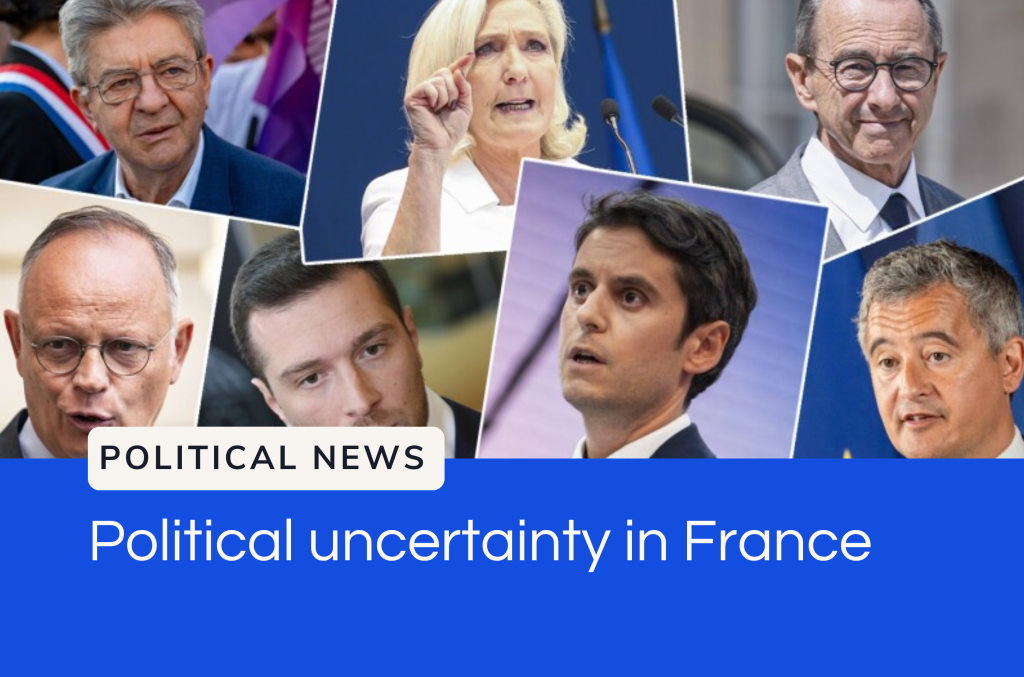
In France, political uncertainty is not just an issue followed closely by investors and economists. It is having a direct impact on business decisions: investments are being postponed, budgets are being managed more cautiously, projects are slowing down, and recruitment plans are being put on hold.
This is, at least, a trend we are hearing about increasingly often in our conversations with decision-makers in the banking and insurance sectors.
The situation is particularly telling: Executive Committees (ExComs) are not necessarily giving up on recruitment. Rather, they are becoming more hesitant to make decisions today when the consequences could look very different tomorrow.
This cautious approach comes at a time when France’s growth prospects remain fragile and economic visibility is still limited. Both the Banque de France and the OECD have highlighted the importance of political and fiscal uncertainty in shaping the outlook for economic activity and investment. (Source: Reuters)
1. Uncertainty that extends beyond the electoral calendar
France is gradually entering a particularly sensitive political period as the 2027 presidential election approaches.
But reducing the current situation to the next election would be too simplistic.
What concerns businesses most is the uncertainty surrounding the environment in which they will have to operate.
What will be the future trajectory of public finances?
What will the tax landscape look like in the years ahead?
How will social security and healthcare spending be funded?
What decisions will be made regarding pensions?
What regulatory changes will affect businesses and financial institutions?
What impact will these changes have on labor costs?
These questions do not directly affect every recruitment decision. However, they influence a key variable for business leaders: their ability to forecast profitability and remain competitive.
The Banque de France had already highlighted how political and fiscal uncertainty could encourage businesses and households to adopt a wait-and-see approach. (Source: Banque de France)
More recent OECD analyses continue to point to subdued growth prospects for France, against a backdrop of persistent uncertainty. (Source: OECD)
2. Why this directly affects recruitment
An investment can be postponed.
So can a project.
But hiring someone on a permanent contract (CDI) is a more significant commitment than a one-off budget allocation.
It involves an organization, payroll costs, objectives, and sometimes the creation of a new team or the expansion of a business activity.
For a business leader lacking visibility over the next 12 or 24 months, the question is therefore no longer simply:
“Do we need this profile?”
It becomes:
“Are we sufficiently confident that we will need this profile to commit now?”
That is a fundamental difference.
In our conversations with decision-makers, we are seeing positions that genuinely exist and for which the need has been clearly identified, but whose opening is sometimes postponed by a few weeks or months.
Not because the company no longer wants to hire.
But because it first wants to understand what its future operating environment will look like.
➠Do you work in niche areas such as actuarial science, quantitative finance, risk, or compliance?
For over 15 years, we have collaborated with leading financial institutions and insurance firms. As market leaders in France, we are entering a phase of acceleration, with ambitious projects planned over the next three years. Our goal is to solidify our presence in France while expanding primarily into Germany and Luxembourg to strengthen our position across Europe. Explore our open positions or contact us if you are currently recruiting in our niches.
3. Banking and insurance: particularly sensitive sectors
In banking and insurance, this issue takes on a particular dimension.
Regulatory and budgetary changes can directly alter the economic balance of certain business activities.
In the insurance sector, uncertainty surrounding the funding of social security, healthcare, or pensions can also weigh on investment, organizational and, ultimately, recruitment decisions.
In banking, investment decisions, changes in taxation, growth prospects, and even the attractiveness of France as a financial hub can also factor into executives’ decision-making.
For an international organization, the question can become even broader:
Why invest or strengthen a team in France today rather than in another European market?
Political uncertainty then becomes one factor among many in decisions about where to allocate investment.
4. The paradox: the needs are still there
This is probably the most important point to emerge from our observations.
We are not seeing a disappearance of recruitment needs.
We are seeing greater selectivity when it comes to hiring decisions.
The positions that continue to be opened are often those whose value to the organization is immediately clear:
rare expertise;
regulatory or strategic roles;
essential replacements;
the development of revenue-generating activities;
technological transformation;
skills that are difficult to source internally.
In other words, when visibility decreases, the level of justification required to open a position increases.
Recruitment increasingly becomes an investment rather than simply a response to a staffing need.
5. External support can help address some of this uncertainty
This shift also helps explain why the external staffing and permanent employment markets can respond differently.
When a company has an immediate need but limited visibility into its medium-term organizational structure, a temporary resource can sometimes provide a more flexible solution.
By contrast, a permanent hire requires greater visibility into the long-term sustainability of the need and the associated budget.
This does not mean that external staffing replaces permanent employment.
The two address different business needs.
However, in an uncertain environment, flexibility naturally becomes an additional factor in decision-making for business leaders.
6. The real issue: the cost of waiting
However, there is a risk in waiting too long.
In some roles, particularly niche areas of expertise within banking, insurance, and asset management, top talent remains scarce.
Delaying a hiring decision can therefore come at a cost.
The position may still be needed six months from now.
But the candidate who is available today probably won’t be.
That is the paradox of the current situation:
the more uncertain the environment becomes, the more companies want to wait; but the longer they wait, the greater the risk of losing the skills they will need tomorrow.
7. Recruitment is not disappearing. The decision-making criteria are changing.
This is probably the key trend we are seeing in our conversations with business leaders.
In a period of strong visibility, a company can hire to support an ambition.
In a period of uncertainty, it will first hire when it considers a particular skill set essential to achieving that ambition.
The difference is significant.
It explains why some recruitment needs remain an absolute priority while others are postponed.
It also explains why having an in-depth understanding of the talent market is becoming even more important for companies.
Conclusion : Our perspective
At Émérique & Partners, our role puts us at the intersection of two realities: companies’ strategies and professionals’ expectations.
Our conversations with decision-makers in banking, insurance, and asset management give us a direct view of how economic, regulatory, and political uncertainty translates into recruitment decisions.
Our conclusion today is simple: uncertainty slows down decision-making. It does not eliminate the need for skills.
Companies will continue to hire.
But they will likely be more selective about the positions they open, more demanding when assessing candidates, and more focused on the return on investment of each hire.
In this context, the question may no longer be:
“Should we hire?”
But rather:
“Which hire is strategic enough for us to decide to make it now?”
This is probably where part of the employment market in banking and insurance will be shaped over the coming months.
And alongside this economic, political, and regulatory uncertainty, another question is now emerging: the impact of artificial intelligence on organizations, roles, and skills.
For Executive Committees, the question is no longer simply which profiles to hire today, but also which skills will remain strategically important tomorrow.
➠ Discover the career opportunities available with our prestigious clients.
Visit our job page where you will find our permanent job offers and our external service missions.


Auteur : Emerique Opou
Funder and CEO of Emérique & Partners
London, United Kingdom
Named to Staffing Industry Analysts’ Global Power 150 Women in Staffing list in 2022, Emérique brings over 15 years of expertise in recruiting highly specialized talent across banking, insurance, and asset management.
Her extensive pan-European experience has allowed her to build a robust network of professionals, particularly in actuarial science, quantitative finance, risk, audit, and compliance.
Under her leadership, Emérique & Partners has achieved remarkable industry recognition:
- Finalist, ‘Entrepreneur of the Year’, Recruiter Awards, London 2024
- Finalist, SME National Business Awards – ‘Business Woman of the Year’, UK 2024
- Winner, Agency Recruitment Team of the Year (<20 employees), 2025
- HBC Woman Leader Award (Diamond), 2025
Emérique Opou focuses exclusively on executive and senior management recruitment, delivering tailored solutions for permanent and freelance positions.
Every quarter, Emérique analyses key trends in the French and European banking and insurance markets, ensuring her clients stay ahead in a rapidly evolving industry.
If you operate in the banking or insurance sector and are looking for niche permanent or contract talent, reach out to Emérique & Partners :